Welcome to Shanghai Yiguang Laboratory Equipment Co.,Ltd!

Laboratory Planning/Design
Installation after-sales in one

+86 15800400050

Fume hoods are available in a wide range of materials, commonly stainless steel, painted sheet metal, fiberglass, steel wood, PP polypropylene plastic. When making a bulk purchase, consumers will primarily consider quality, longevity functionality. If given the choice between a plastic metal version of an item, most people will consider metal to be the better, stronger, more durable option. Therefore, when purchasing a PCR bench ductless fume hood, many people think they need to buy a stainless steel sheet metal painted fume hood. However, this is really the case, in some real-world applications, plastic may produce better results have a longer lifespan than metal for body construction worktops.
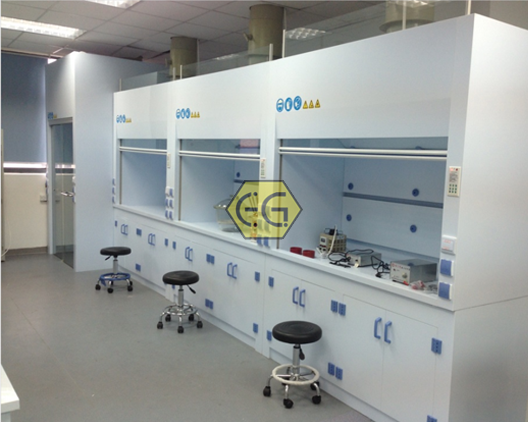
Plastic is superior to metal in three ways, but before we dive into that, it's important to understand the difference between the plastics used for fume hoods the ordinary plastics you encounter in everyday life. The plastics used to build fume hoods are different the ordinary plastics used to make children's toys. There are manufacturers who routinely use lab-grade PP polypropylene for worktops building materials, which is a much stronger material than what is used to make toys. Because of its durability, PP polypropylene is an excellent choice for almost any application.
Three properties of PP polypropylene plastic:
I. Non-porous
Lab-grade PP polypropylene is chemically impermeable, non-porous. This means that any substances placed on it will penetrate your work surface. As a result, polypropylene is very easy to clean sanitize, which will help ensure the integrity of your next project. Many of the seams on lab PP equipment are heat welded for beautiful, well-integrated seams that make cleanup much easier; no chemicals substances will get into the deep seams on the back of the bench. This welded polypropylene construction facilitates operator process protection of the product.
Polypropylene is chemically permeable, which also means that it is significantly more resistant to certain substances, such as acids, than stainless steel. If a stainless steel worktop is used, it can cause serious rusting problems, in some cases requiring frequent care even replacement of the equipment. This is even possible with polypropylene. Because polypropylene is chemically resistant, there are virtually no commonly used substances that will corrode seriously damage a worktop fume hood structure.
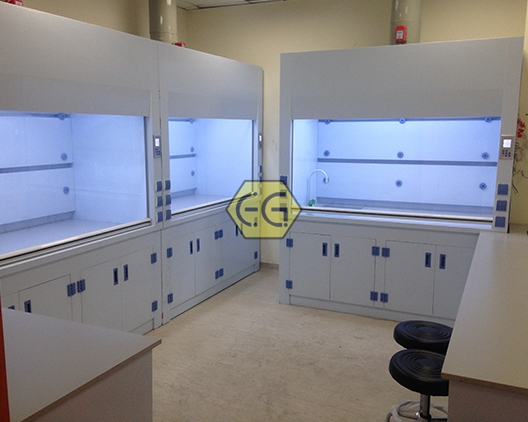
II. Absorption of vibration
When using a ductless clean-air fume hood, the blower is usually very noisy can be distracting. If the unit is also made of stainless steel, it will vibrate noticeably, creating more noise.PP polypropylene units are much quieter because the plastic absorbs vibrations rather than transmitting them. This helps make your workspace quieter therefore more pleasant to work in.
Additionally, polypropylene absorbs dissipates vibration, which also has an impact on your work. Reduced vibration can lead to easier more accurate weighing, which is especially important when using PP ductless weighing cabinets. Less vibration will also allow you to work on a more stable plane, like a marble slab. This provides the stability needed for high precision work.
III. Temperature Stability
Due to the variety of heating applications in laboratory operations, many people are concerned that PP polypropylene is less heat resistant compared to stainless steel, fearing that the polypropylene will be able to withstand the heat will melt easily. This is a common misconception. Laboratory grade PP polypropylene can withstand a lot of heat is actually heat resistant. More importantly, heat sources rarely, if ever, come into direct contact with the work surface. Polypropylene surfaces are never melted damaged by ambient heat generated by a heat source.
Polypropylene can even perform better than stainless steel when handling heat because it does conduct heat. Therefore, if you are working with hot items, the work surface will get hot add heat to your lab application. Polypropylene surfaces will provide temperature stability for your lab application.
Overall, compared to stainless steel, polypropylene is the perfect material for almost any application. The non-porous surface is easy to clean does rust, the vibration absorption helps create a quieter environment makes precision work easier, it is strong enough to withstand high temperatures. Using polypropylene fume hoods can help you do a better job with your lab applications.

Mobile:+86 15800400050
Website:www.egpplab.cn
Seat:+86 21-37026685*808
Address:
No. 8 Hongshan Road, Lingbi North Development Zone, Suzhou City, Anhui Province
No. 188 Minfa Branch Road, Yexie Town, Songjiang District, Shanghai
No. 88 Haitai Road, Dongtai City, Jiangsu Province
 | ||

